WELCOME TO MARIO'S HOTEL IN FLORENCE

Welcome to Mario’s 3 Star Hotel in the Renaissance city of Firenze. With a cosy and friendly atmosphere and a great central location, Mario’s is a family run Guest House style hotel which offers comfort and service with a smile to guests from all over the world. Blending the old world charm of Florence in the fixtures and fittings of a 17th century building with the modern luxuries and comforts expected by today’s traveller, The Florentine hotel owners Leonardo and his brothers like to personally afford each and every guest that personal touch and leave you with happy memories of a pleasant and fruitful stay in Florence.
Visualizzazione post con etichetta guest house. Mostra tutti i post

sabato 17 aprile 2010

OUR STAFF HELPS YOU IN VISITING FLORENCE


Florence keeps an exceptional artistic heritage, marvelous evidence of its secular civilization.
The works of great Italian art, Cimabue, Giotto, Brunelleschi, Donatello, Leonardo, Michelangelo, are gathered in numerous museums including the Uffizi, a key step for those visiting the Tuscan capital.
Great monuments are the landmarks florentine artistic culture: the Baptistry, the Duomo, the medieval churches, the public and private buildings, monasteries and cloisters, monasteries and the Certosa.
World Heritage Site recognized by UNESCO in 1982, the historic center of Florence, enclosed by a circle of paths traced over the old medieval walls, collects the most important cultural heritage of the city.
The old town can be appreciated in its entirety from the surrounding hills, especially by the Forte Belvedere, from the Piazzale Michelangelo with the Romanesque Basilica of San Miniato al Monte and the hills of Fiesole, which offers one of the most beautiful views of Arno valley.

giovedì 15 aprile 2010

Parking available in Florence at Hotel Mario's

Hotel Mario's doesn't get an own parking space. In the area where we are situated, in the heart of the city centre, it's not easy to find hotel with garage, but what we offer is a very good service with a parking just 50 metres far away from the Hotel. We have an agreement in place with Garage Palacongressi in piazza del Crocefisso, 1. They deal with the regularization of your entry into ZTL (Traffic Limited Zone), so allowing you to drive through the areas normally forbidden to not-authorized vehicles even if to get here at the Hotel you could pass from viale Lavagnini and then taking Via Santa Caterina d' Alessandria; this is not a ZTL area and you need no permission. Anyway, the parking will communicate automatically to the system that your car is allowed to drive in the centre of the city.The garage is located in a crucial point of Florence and it is controlled and safe, according to the currently European rules.There is a manual and automatic internal and external car wash, directly in the garage if you would require.
This is a fantastic service, you don't need to park far from where the Hotel is and is absolutely the private parking most cheap of the centre of the city.
Give a look to the information and when you'll be here at Hotel Mario's you know you can consider this option of Garage Palacongressi ( http://www.cb512parcheggi.it/ ). Hotel Mario's, in the heart of the beautiful city of Florence, Italy.

domenica 11 aprile 2010

Piazzale Michelangelo: a panoramic view


Piazzale Michelangelo is a famous square with a magnificent panoramic view of Florence, Italy and is a popular tourist destination in the Oltrarno district of the city. The view from this most famous observation point of the city landscape has been reproduced in countless postcards and snapshots over the years.
It was built in 1869 and designed by architect Giuseppe Poggi on a hill just south of the historic center, on completion of retraining of the left bank of the shore. From that fact, Florence was the capital of Italy and the whole city was involved in an urban renewal, the so-called rehabilitation, or the rebirth of the city middle class: they were created lungarni; on the right bank, instead of the fourteenth-century walls were open the avenues of the ring of a boulevard, on the left bank was traced, wind on the hill of San Miniato, the Viale dei Colli, a street tree overview 8 kilometers long, at whose climax the square was built as a terrace with a panoramic view inside the city. The chronicle of the early construction of the company has been described in detail by the Italian journalist Peter Ferrigno (known under the name of Yorick) that does not fail to report as a part of Florence is dispiacesse "for the excessive spending of the construction.
The square Michelangelo square, dedicated to the great Renaissance artist Michelangelo, has copies of some of his famous works in Florence: the David and the four allegories of the Medici Chapel of San Lorenzo. These copies are made of bronze, while the originals are all in white marble. The monument was brought up by nine pairs of oxen on 25 June 1873.
Poggi designed the loggia in the neoclassical style that dominates the whole terrace, which today houses a panoramic restaurant. Originally it was supposed to house a museum of works by Michelangelo, ever. In the wall of the balcony, under the loggia, an epigraph is a banner characters reminiscent of his work: Florentine architect Giuseppe Poggi turn around here is his monument MCMXI.
The panorama encompasses the heart of Florence from Forte Belvedere to Santa Croce lungarni through the bridges of Florence and in sequence, especially the Ponte Vecchio, are the Duomo, Palazzo Vecchio, the Bargello and the octagonal bell tower of the Badia Fiorentina, without forgetting opposed to the hills north of the city with the center and Settignano Fiesole.
The square can be accessed by car along the tree-Viale Michelangelo, made in those same years, or walk the stairs going up the ramps of the monumental Piazza Poggi Poggi in the district of San Niccolò.

giovedì 25 marzo 2010

The via Francigena


The Via Francigena is a historical itinerary leading to Rome from Canterbury, a major route which in the past was used by thousands of pilgrims on their way to Rome.This route bears witness to the importance of the practice of pilgrimage in medieval times; the pilgrim was to travel mostly on foot (for penitential reasons), covering about 20-25 Km a day,and was driven by a fundamentally devotional reason: the pilgrimage to the Holy Sites of Christianity.The road road is between Rome and Canterbury, passing through England, France, Switzerland and Italy.The Via Francigena was the major medieval pilgrimage route to Rome from the north; even today pilgrims travel this route, but in far fewer numbers than the Way of St. James (Camino de Santiago).
The Via Francigena is not just an important pilgrimage route concerning a large area of Italy, but its discovery represents a unique opportunity to get in touch with the places it runs through: an extremely rich heritage of culture, art, history, lovely natural spots and warm hospitality.he Way of Saint James originated and was supported as a defensive bulwark against Islam; the Via Francigena was just one of the many routes leading to Rome or, at most, the converging path of many different trails and during past centuries was never supported by political will. Stretches of the ancient trail have remained intact: in Castellonchio, a few miles before Berceto and nearby the pass of Monte Bardone or in Galleno (Tuscany) or, further South in Capranica, near Viterbo; here you can still walk through age-old hazel groves linked to the memory of Charlemagne and chivalric literature or on the grass-overrun paving stones of the Roman Via Cassia, which is still in perfect conditions in Baccano, near Rome.

IN TUSCANY

Today the Via Francigena enters Tuscany at the Cisa Pass in the area called Lunigiana north of Pontremoli and heads south toward Acquapendente in Latium passing through Lucca and Sienna. It is still possible to follow approximately the ancient road and to find refuge in most of the same villages mentioned by Sigeric. The route passes through four distinct geographical areas where the landscape, the building materials and the gastronomic traditions follow their own local traditions, occasionally still reflecting mediaeval influences.The first of these four areas begins at the Cisa Pass, the crossing point from the Region of Emilia Romagna into the Region of Tuscany, north of Pontremoli in the Appennine mountains, and follows the valley of the Magra river down to Aulla and Sarzana. This area is called Lunigiana, after the Roman port city of Luni.This area is characterised by castles, walled mediaeval villages and isolated monasteries, constructed primarily of the gray limestone found locally.The second area begins at Sarzana and goes past Lucca to Altopascio. The principal characteristic of this sector is that the road hugs the foot of the Appuan alps and stays inland from the sea coast. The main towns one sees are Sarzana, Carrara, Massa and Pietrasanta, all in the marble working area, and Camaiore which is the only village mentioned by Sigeric after Luni.The third sector is the longest segment of the Francigena and runs from Altopascio, down to Fucecchio, and on to Sienna passing through Castelfiorentino, Certaldo, Poggibonsi, San Gimignano and Monteriggioni before it arrives in Sienna. The fourth sector begins in Sienna and goes south to Abbadia San Salvatore.From Sienna south, the Via Francigena closely follows the Via Cassia, another of the old roman roads. Visits to Isola d'Arbia, Buonconvento, Montalcino, the Abbey of Monte Oliveto Maggiore and San Quirico d'Orcia are all worthwhile. However the last two stops of Sigeric, Bagno Vignoni and Abbadia San Salvatore, are the most spectacular. Bagno Vignoni is where for centuries people have gone for health cures because the sulphur water baths.
When you walk through Tuscany, why don't stop for some days in Florence? At Hotel Mario's you could enjoy some rest days and visit the city from a spectacular position.
We are waiting for all of you pilgrims and walkers.

venerdì 19 marzo 2010

Arno


The Arno is a river in the Tuscany region of Italy. It is the most important river of central Italy after the Tiber.
The river originates on Mount Falterona in the Casentino area of the Apennines, and takes initially a southward curve. The river turns to the west near Arezzo passing through Florence, Empoli and Pisa, flowing into the Tyrrhenian Sea at Marina di Pisa. With a length of 241 kilometers, it is the largest river in the region. Its main tributaries are: the Sieve (60 kilometers), Bisenzio (49 kilometers), Ombrone, Era, Elsa, Pesa and Pescia. The drainage basin amounts to more than 8,200 km² and drains the waters of the following sub-basins:
* The Casentino, in the province of Arezzo, formed by the upper course of the river until the confluence with the Maestro della Chiana channel.
* The Val di Chiana, a plain dried in the 18th century, which, until the 18th century, was a marshy area tributary of the Tiber.
* The upper Valdarno, a long valley bordered from East by the Pratomagno massif and from West by the hills around Siena.
* The Sieve's basin, which flows in the Arno immediately before Florence.
* The middle Valdarno, with the plain including Florence, Sesto Fiorentino, Prato and Pistoia.
* The lower Valdarno, with the valley of important tributaries such as the Pesa, Elsa and Era and in which, after Pontedera, the Arno flows into the Tyrrhenian Sea. The river has a very variable discharge, ranging from minimum values such as 6 m³/s to more than 2,000. The mouth of the river was once near Pisa, but is now several kilometres westwards.
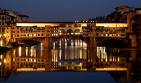
It crosses Florence, where it passes below the Ponte Vecchio and the Santa Trìnita bridge (built by Bartolomeo Ammanati, but inspired by Michelangelo). The river flooded this city regularly in historical times, the last occasion being the famous flood of 1966, with 4,500 m³/s after a rain of 437.2 mm in Badia Agnano and 190 millimetres in Florence, in only 24 hours.
The flow rate of the Arno is irregular. It is sometimes described as having a torrent-like behaviour, because it can easily go from almost dry to near-flood in a few days. At the point where the Arno leaves the Apennines, flow measurements can vary between 0.56 m³/s and 3,540 m³/s. New dams built upstream of Florence have greatly alleviated the problem in recent years.
A flood on November 4, 1966 collapsed the embankment in Florence, killing at least 40 people and damaging or destroying millions of works of art and rare books. New conservation techniques were inspired by the disaster, but even 40 years later hundreds of works still await restoration.

mercoledì 3 marzo 2010

Why Hotel Mario's, why Italy?

Hotel Mario's is an old style Hotel in the heart of the city of Florence.Have you ever been in Italy? Italy is called Belpaese, "Beautiful country" because of its art,food and style.We are glad to be part of this nation and in particulary, of this city.
Come to Florence and enjoy Hotel Mario's.